A medication reconciliation form is a document that helps clinicians compile patient information, including all current medications, their indications, doses, routes, and frequencies. With Heidi’s AI-powered form-filling features, this form can help you:
Automatically fill out your medication reconciliation form fields
Easily integrate the patient’s past lists with their current medications
Save time on paperwork and focus more on patient care
A medical reconciliation form documents the formal process of obtaining and verifying all the medications a patient is currently taking. This scope extends to prescribed, supplements, herbal, and over-the-counter medications.
In this article, we will talk about the importance of medication reconciliation forms, their different types, the steps to fill them out, and how an AI care partner like Heidi can support you and your care team throughout the process.
Why Are Medication Reconciliation Forms Important?
Medication reconciliation forms are important because complete, updated, and accurate records help support every clinical decision. They also protect patients and keep their course steady and coherent.
Here is a list of the top 5 reasons why having a medical reconciliation form is important.
1. Complies With Legal Requirements
Australia has state-based policies and guidelines that follow a standardized four-step process (documentation, verification, reconciliation, and providing an accurate list of medications). In addition, the Australian Commission on Safety and Quality in Health Care (ACSQHC) mandates medication reconciliation to overall improve patient safety and lessen costs related to healthcare.
Australia also uses the National Medication Management Plan (NMMP). Admission medication reconciliation uses this standardized national form widely. On the other hand, ISMP Canada and the former Canadian Patient Safety Institute created a standard language and tools for MedRec, including in primary care.
The Canadian system for documenting the Best Possible Medication History (BPMH) uses a systematic interview using multiple sources to capture a complete and accurate list. Its standardised medical reconciliation process forms also have fields to categorize each discrepancy and record the action taken.
Clinicians compare the BPMH to orders, resolve discrepancies, and document intentional change at the admission, transfer, and discharge steps.
In the United States, medical reconciliation is considered one part of a seven-foundation approach to safer transitions of care. The Joint Commission developed the National Patient Safety Goal NPSG.03.06.01.
Organizations must improve the accuracy of patient medical records by reconciling new and existing medicines, giving the patient clear written information, and ensuring they carry an updated list to every visit. This reduces the risk of medication error at each transition of care.
2. Reduces Medication Errors
Three years ago, clinicians across the United Kingdom reported 2.2 million patient-interaction incidents to the National Health Service (NHS). Twenty-six percent involved low-harm outcomes. These events included administering an unintended drug or dose, dispensing the wrong medicine, or giving medication to a different patient than intended.
Medication reconciliation involves comparing a patient’s current medication list with a new prescription. This helps prevent duplication errors, incorrect dosing, and omission. A formal process helps lessen medication errors by 50-94%, according to the ACSQH.
3. Facilitates Smooth Handovers
It is important at different points of care transition to ensure consistency in medication therapy. The Canadian Journal of Rural Medicine states that a significant 40% of medication errors can be attributed to flaws in the reconciliation process during patient handovers, as well as breakdowns in communication.
Complete medication reconciliation forms provide clinicians with a single source for the patient’s full medication history, current therapies, recent changes, and the clinical reasoning behind those changes, and prevent avoidable errors usually incurred when medical practitioners verbally share information in busy environments and when only partial data is given.
4. Improves Patient Outcomes
Accurate medication reconciliation forms strengthen patient outcomes and help health services use resources more wisely by preventing error-related care. Readmissions can become less common as well because patients leave with an accurate and simple medication plan.
5. Promotes Clinical Accountability
The process of medical reconciliation affects and links various stakeholders, including physicians, specialists, pharmacists, nurses, and even the patient. Shared accountability is upheld through the usage of standard forms and observation of processes. This is crucial to practice medication safety.
Heidi automates the burden of filling out forms, among other administrative tasks. This helped Dr. Alexander Ho in his challenges of managing multilingual consultations and keeping his documentation more efficient and consistent.
After integrating Heidi into his workflow, he can now be more present when seeing his patients and spends less time typing. “I use it for all my consults. It’s accurate for my use, and it saves me a lot of time,” he shares.
Dr. Ho’s experience indicates that when clinicians can be fully present in their patient interactions, information recorded in each encounter becomes more accurate. The process of medication reconciliation becomes clearer, safer, and faster to complete.
Types of Forms For Medical Reconciliation
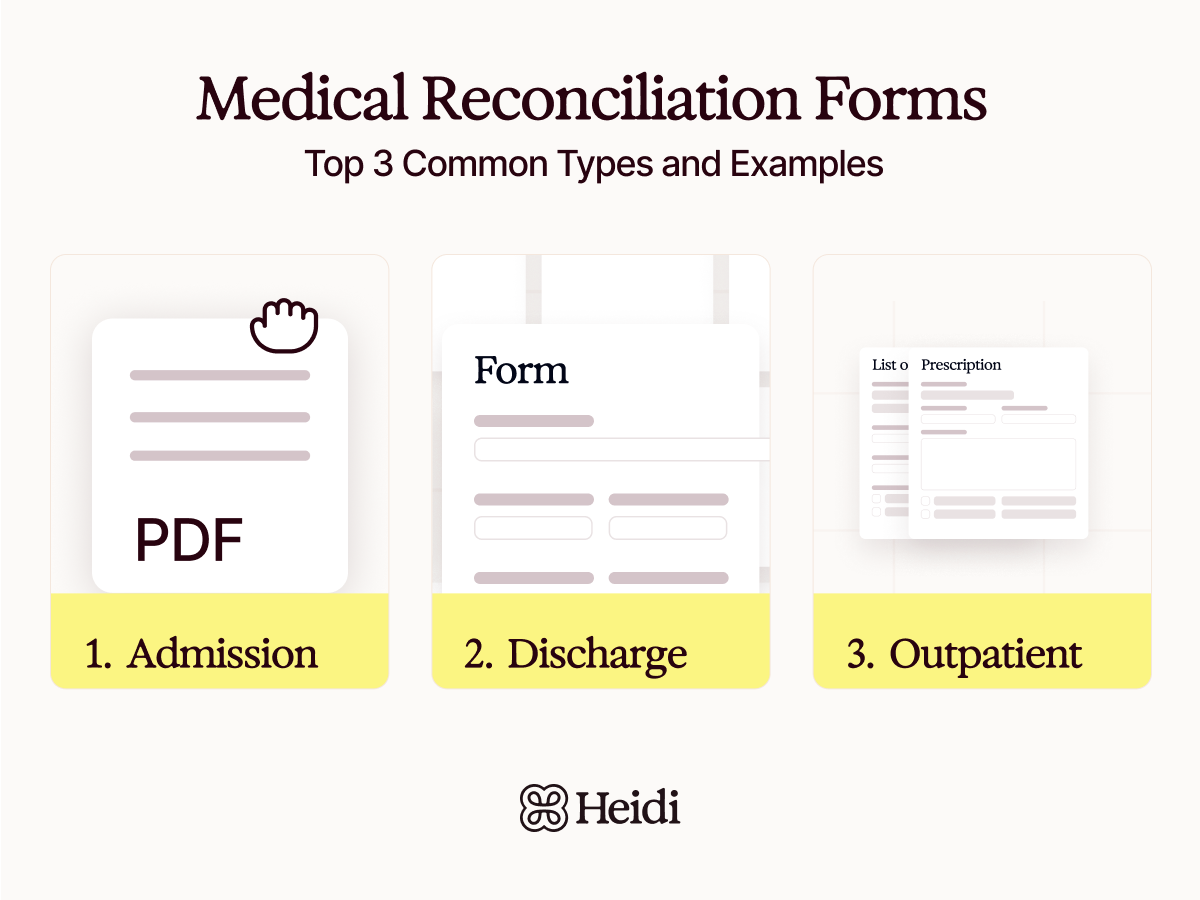
Healthcare facilities use a variety of standardized forms designed for every step of the hospitalization process. The elements in each type of medication reconciliation form primarily depend on their specific purpose, care setting, and clinical workflow. These include the following:
Admission Medication Reconciliation Form
Entrance to a facility like a hospital or clinic requires this kind of form. It helps establish the baseline BPMH efficiently and as soon as possible. Generally, this type of medication reconciliation form is filled out by GPs who then hand it over to specialists to collect and confirm the patient’s medication history.
Discharge Medication Reconciliation Form
This type of medication reconciliation form is the final list that is given to the patient and their primary care provider (either GP or family medicine specialist). It needs to document the changes made during the hospitalization period and any medications currently stopped.
The discharge medication form has to be readable and easy to use because patients tend to struggle in understanding medical terms, especially when they are sick or in pain. This helps patients understand their medical conditions and the purpose of their medications better, leading to more informed future medical decisions.
Outpatient Medication Reconciliation Form
Healthcare providers, like clinicians in clinic groups and outpatient departments, use this form to produce an accurate and complete list of all current medicines, especially non-prescribed ones, before issuing a new prescription.
After identifying the appropriate form for medication reconciliation, clinicians can now proceed with the process of completing the form.
Completing a medication reconciliation form involves a systematic approach to ensure accuracy and patient safety. The following section outlines the step-by-step process of completing medication reconciliation forms effectively, starting with the collection of BPMH.
Step 1: Collect the BPMH
Here, a complete list of the patient’s medications is gathered from reliable sources. This includes prescriptions, over-the-counter medicines, supplements, and herbals.
Heidi assists in this step with its Transcript feature, which captures information in real time and supports automatic language detection. This helps keep details accurate during complex or multilingual conversations.
Step 2: Comparison and Clarification
The BPMH is then compared with the current medication orders relevant to the patient's stage of care. This step involves confirming the purpose of each medication, validating the dose, route, and schedule, and documenting allergies or reactions clearly.
The Heidi Context feature strengthens this step by surfacing relevant details from prior notes and integrating them into the new documentation.
Step Three: Reconciling and Resolution
Any discrepancies between the lists are identified and resolved. Clinicians decide which medications to continue, adjust, or discontinue and record the clinical reasoning behind these decisions.
The Ask Heidi feature supports this step by retrieving medication information, clarifying names or side effects, and helping differentiate similar drugs when needed.
Step 4: Communicating The Final List
The updated medication list is documented and shared with the patient, caregiver, and the next care team involved. This ensures each party has a clear, unified reference point moving forward.
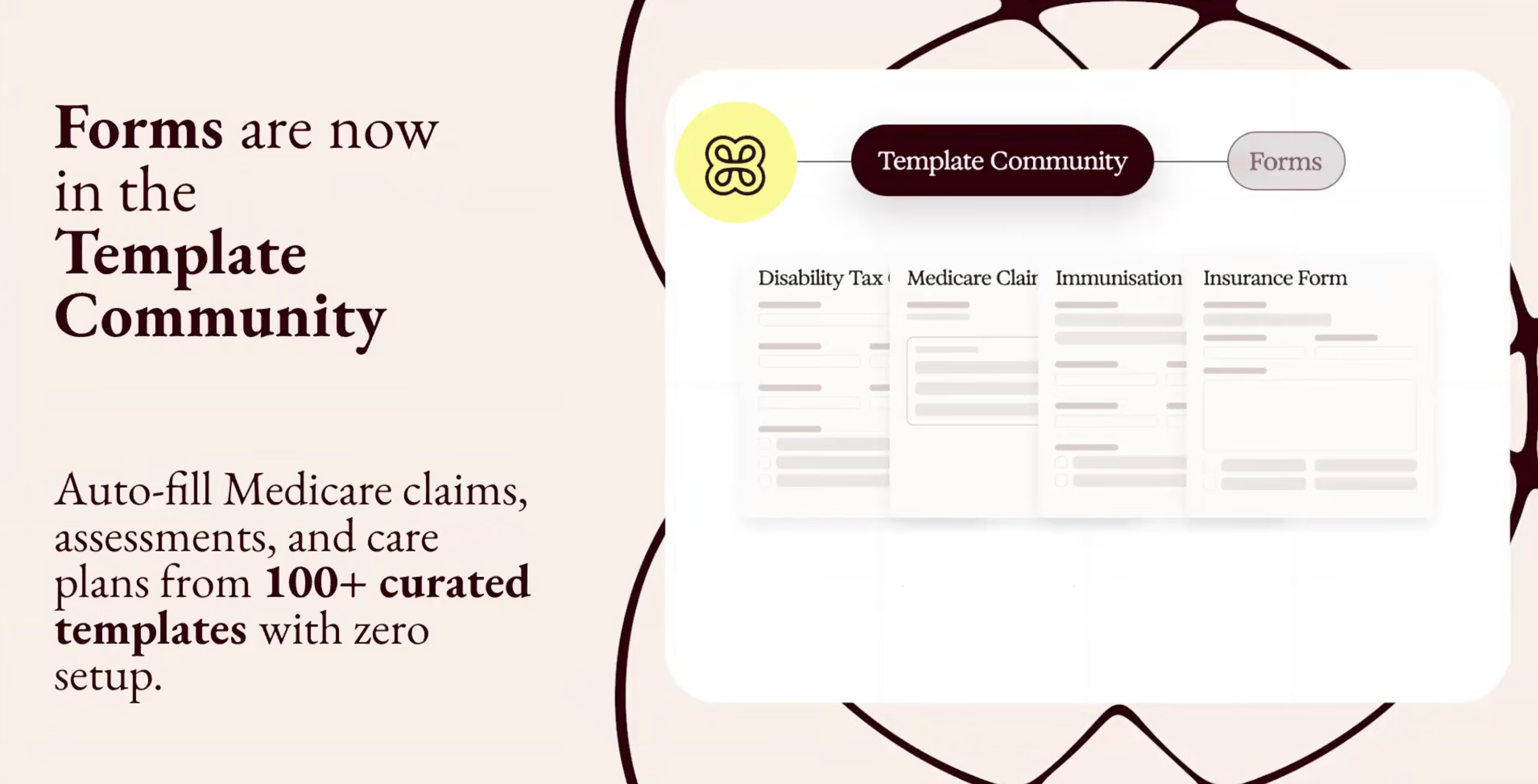
Heidi supports this step through Form templates, which can be standardized or customized for specific workflows, helping clinicians maintain clarity across transitions of care.
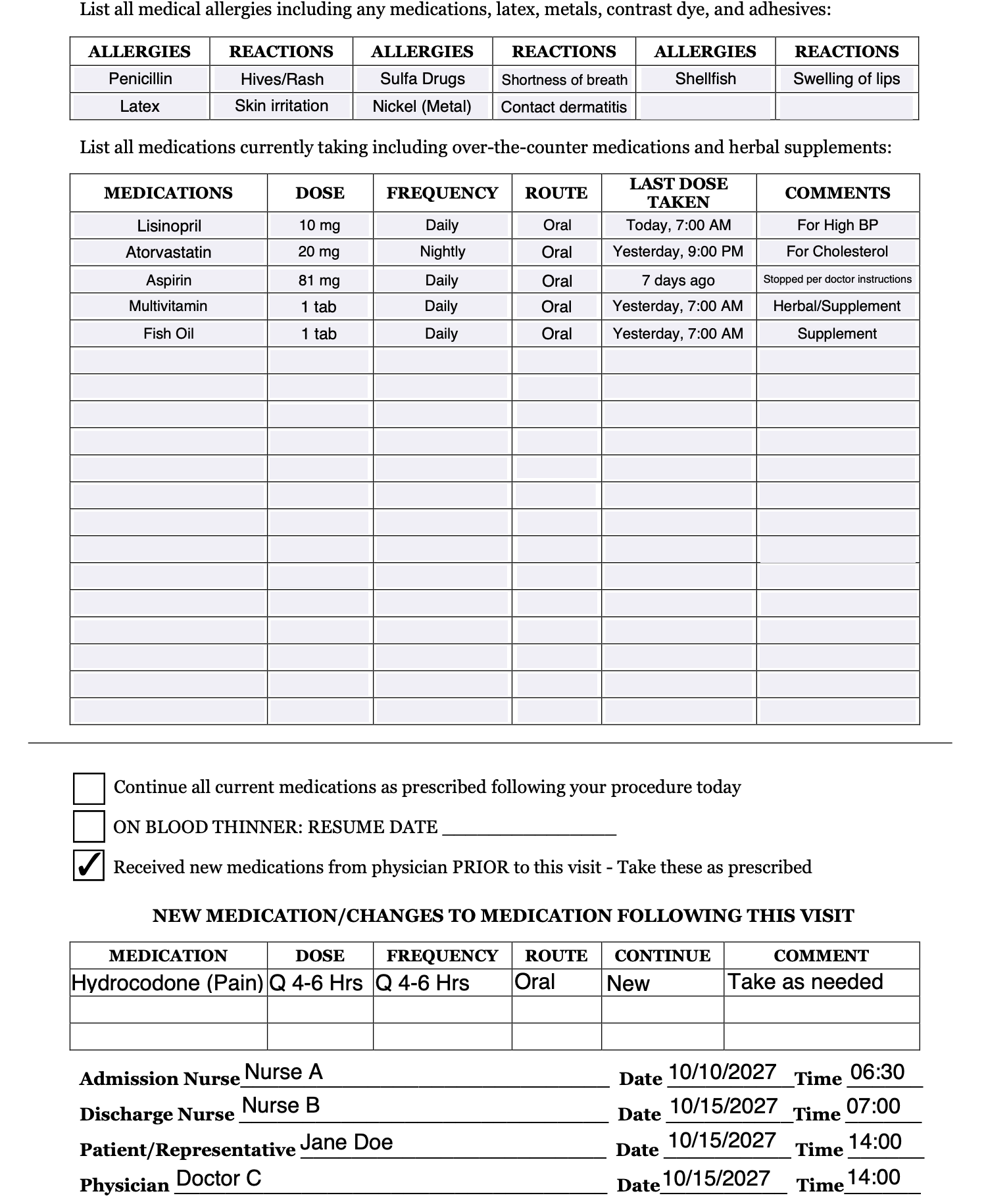
Medication Reconciliation Form Sample PDF
Sample PDF automatically filled by Heidi for demonstration purposes only. No PHI or PII was used. Content is from a simulated session and not based on real individuals.
It is important to acknowledge that incomplete medication reconciliation can occur when workflows are fragmented, when patient knowledge is limited, or when records across settings are not fully aligned. Clear documentation and structured forms help reduce these risks.
Heidi: By Your Side In Every Process
Heidi supports clinicians through each stage of the medication reconciliation process by keeping information clear, organized, and easy to move between teams. It captures what happens in the room and prepares it for the next step in care without adding extra work to the clinician’s day.
Its form-filling capabilities allow clinicians to auto-generate complete medication documents directly from the details already gathered during the consult, reducing the need to rewrite or manually transfer information.
You can use these form capabilities by following a few simple steps:
Upload the formatted PDF form you want to use
Select the form template within Heidi
Review as Heidi completes the form based on the session (and context) details
Heidi supports millions of clinical interactions each week and maintains strict region-specific privacy standards. Helping clinicians stay aligned with regulatory requirements, Heidi also ensures that documentation is consistent, accurate, and ready for the next care provider.
Frequently Asked Questions about Medication Reconciliation Forms
Who is allowed to do a medication reconciliation?
Medication reconciliation can be completed by various members of the care team, depending on the setting and local policy. Physicians, nurses, and pharmacists typically lead the process, with each role contributing information from their perspective to ensure accuracy.
What is the standard process for medication reconciliation?
Most frameworks follow a similar structure, but the exact steps may differ between hospitals and health systems. In general, teams gather a complete list of the patient’s medications, review it alongside current orders, resolve any inconsistencies, and update the shared record so the next provider has an accurate reference.
What are the 10 golden rules of medication?
The “10 golden rules” act as safety principles for medication administration. They outline the importance of verifying the correct patient, medication, dose, route, timing, and documentation, as well as the right assessment, education, and ongoing evaluation. These rules support safer prescribing and more consistent patient care.